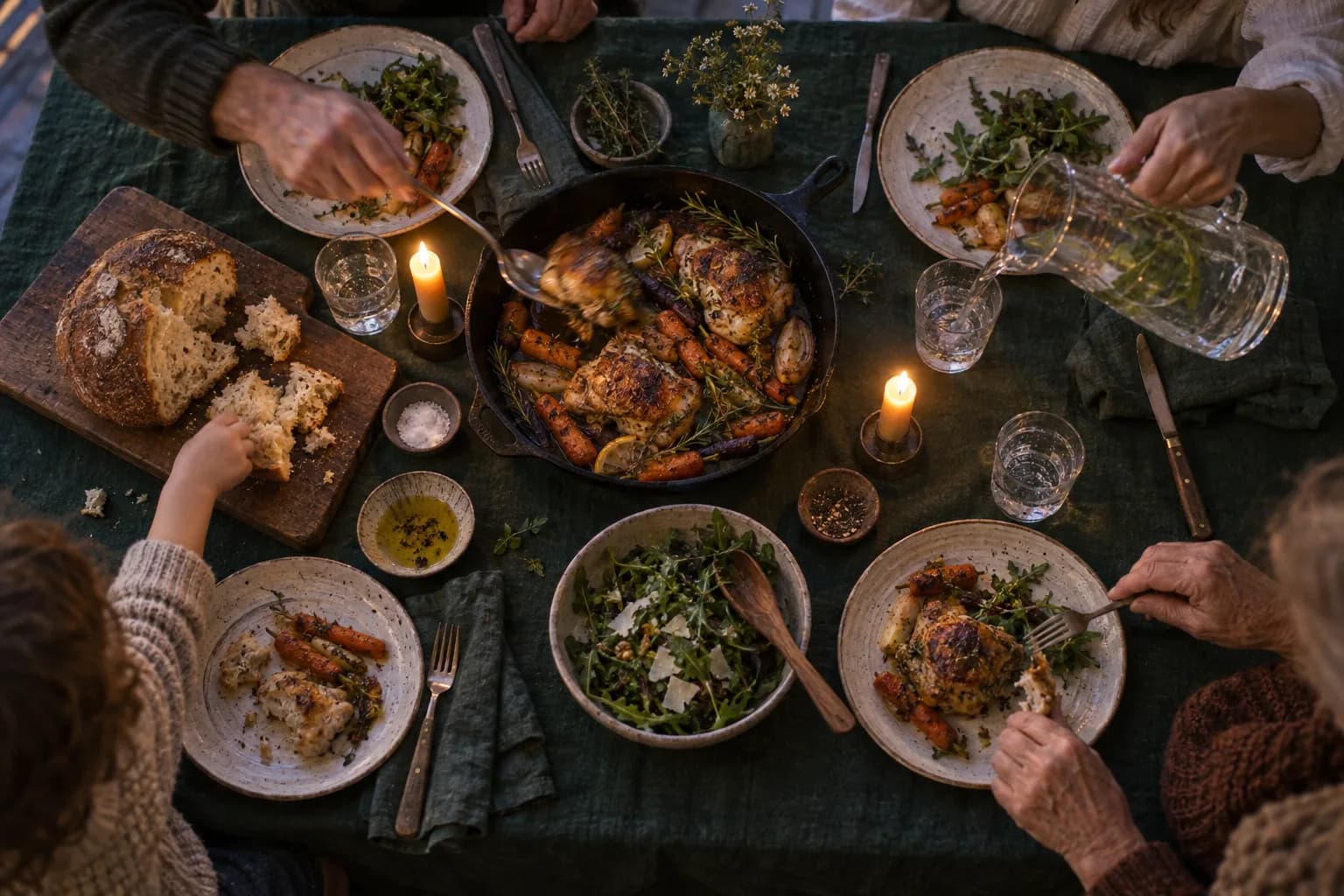
Family table
The 5:47 p.m. problem: deciding dinner is the hard part
Cooking takes an hour. Deciding what to cook takes whatever energy you have left. Why the question is the real work, and what makes it lighter.
Par The Tonight team · 29 septembre 2026 · 5 min de lecture
Cette page n’est disponible qu’en anglais pour le moment.
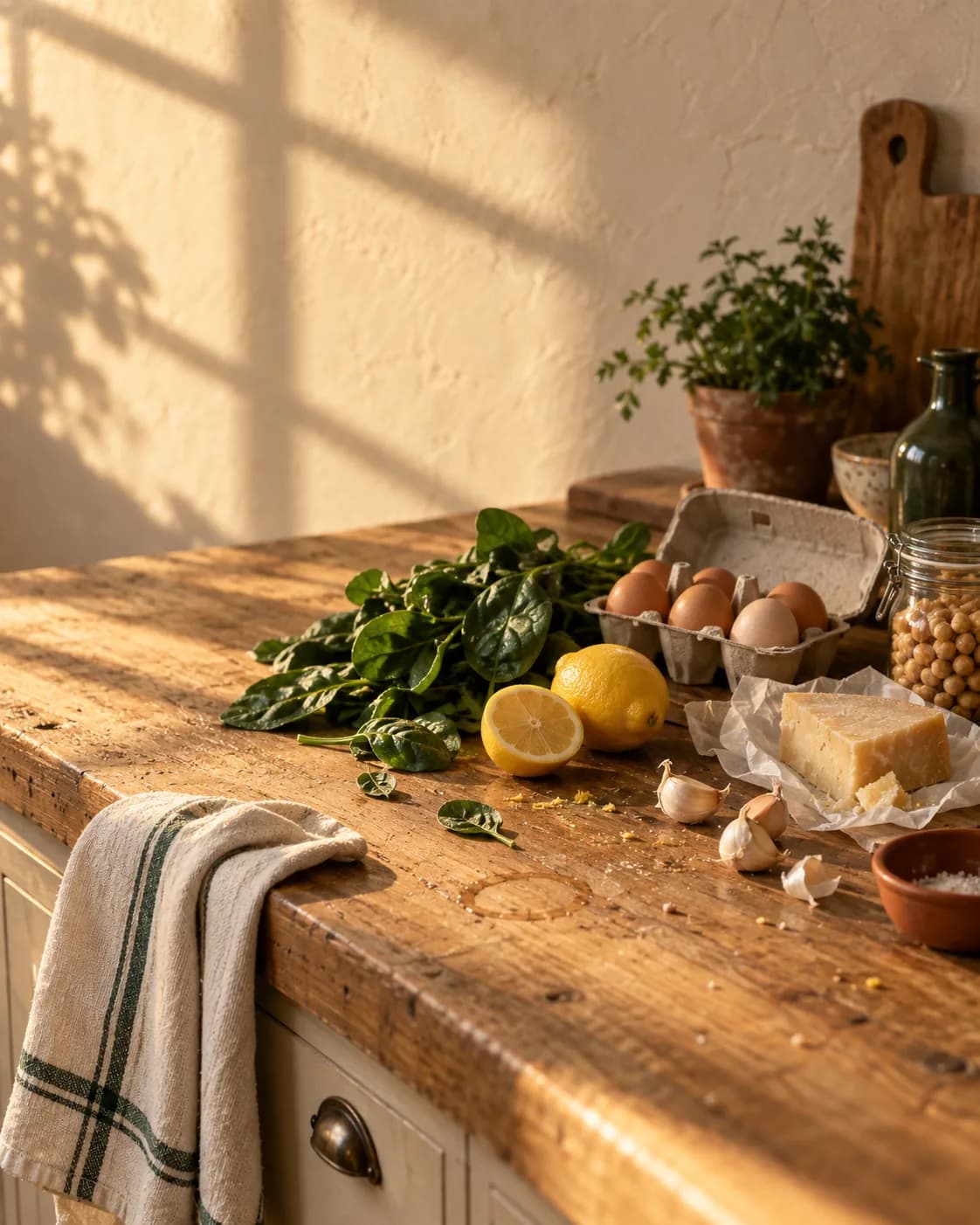
It is 5:47 on a Tuesday. You open the fridge and read it the way you'd read a menu in a language you only half speak. Half a bag of spinach. Three eggs. A lemon that is probably still fine. Behind you, someone asks the question.
You know how to cook. That was never the trouble. The trouble is the standing there, the quiet arithmetic, the feeling that whatever you pick will be wrong for somebody.
The hard part happens before the stove
Cooking is a finite job. It has steps, a beginning and an end, and if you follow them a dinner appears. Deciding has none of that. It is open-ended, it turns up at the worst hour of the day, and tomorrow it wants answering all over again.
People call the wear it causes decision fatigue, and you don't need a study to recognize it. By evening you have answered messages, rearranged a meeting and settled a dozen small disputes, and now you're asked to weigh chicken against pasta while a hungry person watches. The good ideas are gone. Defaults take over: the same handful of dinners, takeout on the wrong night, cereal at eight.
None of that is a failure of character. It is a tired brain doing what tired brains do.
It's also why the fridge stare feels worse than the cooking. Chopping an onion is a task. Standing at the open door, holding the whole week in your head, is a negotiation with yourself.
The job nobody sees
In many households, one person carries the whole map. Not only what's for dinner, but everything dinner depends on. That one child can't have peanuts. That another won't eat anything that touches anything else. That a partner is off meat this month, that practice ends at 6:30, that the chicken has to be used by tomorrow and the rice ran out on Sunday.
This is real work, and almost no one sees it, sometimes not even the person doing it. Nobody thanks you for remembering the lemon. It only becomes visible when something is missing. It rides along to the grocery store, into the car, into the shower. It does not clock out.
Cooking has a start and an end. Deciding does not. That is why an evening can leave you wrung out when all you did was boil pasta, and why the person who plans the meals can be more tired than the person who cooks them.
Five small habits that shrink the question
Nothing makes the question vanish, but a few habits make it smaller. None of them needs an app.
- Decide once for the week. One calm planning session beats seven tired negotiations.
- Keep a shortlist of dinners everyone will eat, and let it grow slowly. A shortlist is a decision you've already made.
- Write the constraints where everyone can see them: allergies, diets, the night with practice. What lives only in your head can only be solved by you.
- Cook once for two nights when you can. Leftovers are a decision made in advance.
- Name a fallback dinner ahead of time. Eggs on toast counts, and calling it a plan takes the guilt out of six o'clock.
Pick one to try this week, not all five. A habit that survives a busy Thursday is worth more than a system that collapses on it, so start small and let it be a little boring.
Cooking has a start and an end. Deciding does not.
What it feels like when one good answer arrives
Picture 5:47 again, but the answer is already waiting. Not a scroll of options and not a recipe feed. One dinner, with the reason attached: it uses the spinach before it turns, it fits the time you have, and your youngest ate the fish last week without a fuss.
You don't get an hour back. You get the question out of your hands. The reason matters as much as the answer, too, because a suggestion you can't question is just another thing to second-guess. When the reason is plain and true, you can accept it in a second, or say “not this” and get something else in another.
That is what we're building with Tonight. It looks at who is home, what's in your kitchen and how long you have, then hands you one dinner and tells you why. There's a button for the nights you have twenty minutes and another for the nights you aren't cooking at all. But the bigger point holds with or without an app. The load is the decision, not the dinner, and you're allowed to put it down.
Ask a smaller question
“What's for dinner?” is enormous. “Which of these two?” is small. Much of the relief comes from shrinking the question before you're tired enough to resent it. Start with whichever piece is easiest to answer: which night is the busiest, which ingredient needs using first, who won't be home.
It also helps to separate deciding from doing. Choose the dinner at a calm moment and cook it at a hungry one, and your two selves stop arguing. The person at the stove only has to follow a plan, and following a plan takes far less out of you than making one.
If you'd like to hand the question to something else for a while, Tonight is free to try for 7 days.