How to reduce food waste at home: what actually works
Most household food waste is food that wasn't used in time. Plan, store, cook and freeze so less reaches the bin, with real numbers and official storage times.
By The Tonight team · · 10 min read
Most household food waste is food that wasn't used in time. That is what the UK waste-reduction organization WRAP found when it looked at why edible food gets thrown away: nearly 40% of it sat unused until it turned. That changes what you should do about it. The fix is mostly ordering: use the perishable things first, freeze what you won't reach, and cook amounts people will actually eat.
So every habit that works shortens the distance between buying and eating. Buy for dinners you've planned. Put the delicate food at the front of the week. Freeze on day two or three, not day five. Below are the numbers behind that, a cheat sheet of official storage times, and a way of planning that spends a bunch of parsley twice.
30–40%
of the US food supply is never eaten
Source: US EPA, United States 2030 Food Loss and Waste Reduction Goal
Where the wasted food comes from
The scale first, briefly. The UN Environment Programme estimated that the world wasted 1.05 billion tonnes of food in 2022 across households, food service and retail, as much as 19% of the food that reaches the consumption stage. Households were the largest source by a wide margin: 631 million tonnes, an average of 79 kilograms per person per year. That is uncomfortable, and it is also useful: unlike the waste on a farm or in a warehouse, this is the part you control.
- Households60%
- Food service28%
- Retail12%
| Households | 60% |
|---|---|
| Food service | 28% |
| Retail | 12% |
Share of the 1.05 billion tonnes UNEP estimated. The figures include inedible parts such as peels and bones.
For the United States, EPA counted 66 million tons of wasted food from retail, food service and homes in 2019, and about 60% of it went to landfills. EPA's goal page says 349 pounds of food waste per person left the human food supply chain that year, and it sets a 2030 target of 164 pounds.
The most useful numbers for a kitchen come from WRAP, which measures UK homes in unusual detail. In 2022 households threw away 6.0 million tonnes of food and drink, and 4.4 million tonnes of that (73%) was edible; the rest was shells, bones and peels. WRAP estimates the edible part costs the average four-person household about £1,000 a year. By weight, fresh produce is the most wasted category, followed by meals (homemade and pre-prepared), bakery, and dairy and eggs.
- Not used in time40%
- Cooked, prepared or served too much25%
- Seen as inedible or not to their liking22%
| Not used in time | 40% |
|---|---|
| Cooked, prepared or served too much | 25% |
| Seen as inedible or not to their liking | 22% |
WRAP reports the first figure as “nearly 40%”. The three causes shown add up to less than 100%, so the remainder has other causes.
Read those three bars as a to-do list. The first is a timing problem, the second a portioning problem, and the third mostly a matter of storage and preference. The rest of this article takes them in that order.
Fix the timing: buy for a plan, then order the week
Timing starts in the shop. Food you bought without a dinner in mind has no deadline, so it waits, and waiting is how a bag of spinach turns to slime. A list built from planned dinners gives every perishable a night. If you've never run a weekly plan, a simple weekly system is a place to start, and the ten-minute Sunday ritual is a habit that keeps it going.
The cheapest waste to avoid is the food you never bought. Before you add a third bag of anything perishable, ask which night uses it. If you can't name the night, leave it on the shelf. A half-empty fridge is not a failure; it is often the sign of a week that was planned.
Then order the week by how fast things turn. Fish, ground meat, poultry and soft greens go on the first two nights. Sturdy vegetables, cabbage and freezer dinners go late. And where two dinners can share a perishable, let them: the parsley you buy for Monday's fish can finish on Wednesday's rice.
Some ingredients make this easy. In our catalog of 148 recipes, lemons appear in 35, parsley in 29, carrots in 26, ginger in 25, scallions in 21, limes in 20, spinach in 17 and cilantro in 16. Parsley or cilantro shows up in 44 of them. If you're holding half a bunch of something, there is usually a dinner that wants the rest.
- Lemon35 recipes
- Parsley29 recipes
- Carrot26 recipes
- Ginger25 recipes
- Scallion21 recipes
- Lime20 recipes
- Spinach17 recipes
- Cilantro16 recipes
| Lemon | 35 recipes |
|---|---|
| Parsley | 29 recipes |
| Carrot | 26 recipes |
| Ginger | 25 recipes |
| Scallion | 21 recipes |
| Lime | 20 recipes |
| Spinach | 17 recipes |
| Cilantro | 16 recipes |
Number of the 148 recipes that list each ingredient. Staples such as onion and garlic are left out.
Source: Tonight recipe catalog (148 recipes, September 2026)
Tonight plans with this in mind. It leans toward dishes that use what's about to turn, it nudges nights that can share an ingredient toward each other, and after a shop a receipt scan fills its picture of your pantry so the shopping list only asks for what the week is missing. That is the same idea as cooking from what you have, with the bookkeeping done for you.
Store it so it lasts, and read the label for what it is
Set the refrigerator at or below 40°F (4°C) and the freezer at 0°F (-18°C). The FDA notes that appliance thermometers are the best way to know, and they're cheap. Then keep the ranges below in your head, or on the fridge door.
| Food | Fridge | Freezer | Note |
|---|---|---|---|
| Raw chicken or turkey parts | 1–2 days | 9 months | Not cooking it by tomorrow? Freeze it today |
| Raw ground meat | 1–2 days | 3–4 months | Use or freeze on shopping day |
| Fresh fish, lean | 1–2 days | 6–8 months | Cook first, or freeze at once |
| Cooked meat dishes, soups, stews | 3–4 days | 2–3 months | Refrigerate within 2 hours |
| Eggs in the shell | 3–5 weeks | Don't freeze | Hard-cooked eggs keep about a week |
| Spinach and leaf lettuce | 3–7 days | Don't freeze | Eat these early in the week |
| Fresh herbs | 7–10 days | 1–2 months | Freeze what you won't use |
| Strawberries and raspberries | 3–6 days | 12 months | Freeze ripe berries before they slump |
| Carrots | 2–3 weeks | 10–12 months | Blanch or cook before freezing |
Meat, fish, egg and leftover times come from the FDA's storage chart. Produce times come from The Food Keeper, 4th edition. Both call the numbers guidelines. Freezer times are for quality only, since food kept frozen at 0°F stays safe indefinitely.
Bread deserves a mention, since bakery is the third most wasted category in WRAP's data. The Food Keeper gives commercial bread three to five months in the freezer, so slice a loaf and freeze half the day you buy it.
Then there is the label. Except for infant formula, a “use by” date is the manufacturer's estimate of best flavor or quality, and the FDA says plainly that it is not a food safety date. That doesn't make every date meaningless, and it doesn't make everything past a date fine. For meat, fish, eggs and leftovers, follow the chart's times, and remember the FDA's rule that perishable food shouldn't sit out for more than two hours (one hour above 90°F). Anything that has sat out longer isn't worth saving, whatever the date says. If someone in your home is pregnant, elderly or has a weakened immune system, follow the stricter official guidance for them and ask their doctor.
Freeze on day two, not day five
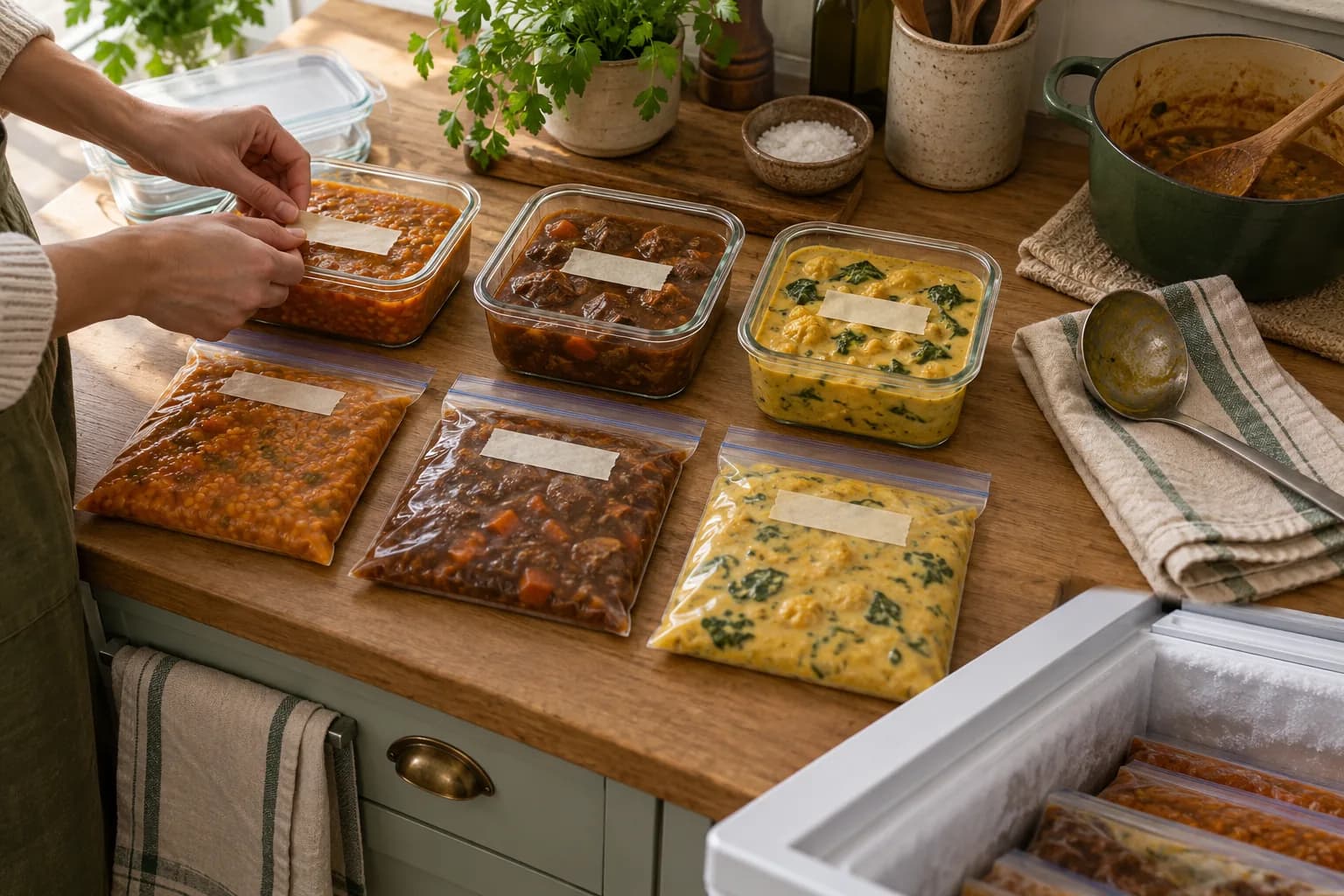
Most people freeze food as a last resort, on the day it is already tired. That's backwards. Freezing is the cheapest storage you have, and the FDA says food kept at 0°F stays safe indefinitely, with the listed times reflecting quality. So move the decision earlier. When you get home from the shop, split the week: what you'll cook in the next two days stays in the fridge, and the other raw meat, poultry and fish goes in the freezer with a date on it.
Freezing suits more dinners than people assume. Of our 148 recipes, 68 (46%) are marked freezer-friendly, and 47 of those are among the 100 free recipes. Freezer-friendly dinners covers which ones hold up and how to pack them.
A fridge clock for the week
- 1
Shopping day: sort before you shelve
Put what you'll cook in the next two days at the front. Freeze the rest of the raw meat, poultry and fish. Date everything that goes in the freezer.
- 2
Days one and two: cook the fast-turning food
Raw poultry, ground meat and fresh fish get one to two days in the fridge, so they take the first nights of the week.
- 3
Day three: cook from the leftovers
Cooked dishes keep three to four days. If a dish has been in the fridge two days and nobody is reaching for it, freeze it now.
- 4
Day four: check the eat-me-first shelf
Anything soft, open or nearly finished goes on one labeled shelf, and tonight's dinner starts there.
- 5
The weekend: one clean-out dinner
Cook from whatever remains: a frittata, a soup, fried rice, a tray of roasted vegetables. Then restock only for the plan.
Cook less of what gets left
A quarter of edible household waste, by WRAP's count, comes from cooking, preparing or serving too much. This one responds to watching more than to rules. For a week, notice what's left in the pot and on the plates: the rice, the pasta, the vegetable nobody loved. Then cook less of it, or plan to use it. Extra rice becomes fried rice. Extra roasted vegetables go into a wrap or a frittata. Extra sauce freezes in a jar.
Deliberate leftovers are a different animal from accidental ones. When you cook a double batch of something that keeps well, you've made a decision in advance, which is the point of any good plan. Cool it, get it into the refrigerator within two hours, and date the freezer portion.
The third bar, food seen as inedible or simply not liked, is mostly a negotiation at the table. Serve small amounts of new things, let people ask for seconds, and see feeding picky eaters for ways to do it that don't turn dinner into a standoff.
Rescue food that is only tired
Limp carrots, wilting greens, bruised fruit and stale bread are all still food. Roast the tired vegetables, or simmer them into a soup. Wilt greens into eggs or rice. Blend overripe fruit into a smoothie, or freeze it for baking. Turn stale bread into breadcrumbs or a bread salad. The rescue works when food is merely past its best. If it has gone slimy or smells wrong, let it go, and don't taste-test meat, fish or leftovers that have been out too long.
It helps to make the rescue routine instead of heroic. One night a week, cook from the eat-me-first shelf without shopping for it, and you'll find that a surprising share of what was headed for the bin makes a decent dinner.
When it's too late for the plate
Some food will still go. Shells, bones and peels are part of every household's waste: WRAP puts inedible parts at 27% of what UK homes throw away, and UNEP's figures include them too. Where you can compost, do: it keeps food out of landfills, and EPA reports that an estimated 58% of the fugitive methane emissions from municipal solid waste landfills come from landfilled food. Its Wasted Food Scale ranks preventing waste as the top priority. In practice that means the order of this article: buy less, use it in time, freeze early.
Questions people ask
How much food does the average household waste?
It depends on the country and the method. UNEP puts the global household average at about 79 kilograms per person per year in 2022, including inedible parts. In the UK, WRAP measured 6.0 million tonnes of household food and drink waste in 2022, about 210 kilograms per household.
Is it safe to eat food past its date label?
For most foods the date speaks to quality. The FDA says a “use by” date is not a food safety date, except for infant formula. Meat, fish, eggs and leftovers have their own storage limits, so follow the FDA chart for those, and discard perishable food that has sat out more than two hours.
How long do leftovers last in the fridge?
Three to four days for cooked meat dishes, soups and stews, according to the FDA's storage chart. Freeze anything you won't eat within that window.
Can I freeze cooked food?
Yes. Food kept frozen at 0°F stays safe indefinitely, and the times on the FDA's chart, such as two to three months for soups and stews, are about quality. Cool it first, pack it airtight and date it. Eggs in the shell and leaf lettuce don't freeze well.
Which foods are wasted most?
By weight of edible parts, WRAP found fresh produce is the most wasted category in UK households, followed by meals (homemade and pre-prepared), bakery, and dairy and eggs.
Sources
- 1.UNEP, Food Waste Index Report 2024 — 1.05 billion tonnes wasted in 2022; 60% households, 28% food service, 12% retail; 79 kg per person from households; PDF copy of the UNEP publication.
- 2.US EPA, United States 2030 Food Loss and Waste Reduction Goal — 30 to 40 percent of the US food supply never eaten; 349 pounds per person in 2019; 164-pound 2030 target.
- 3.US EPA, Food: Material-Specific Data (2019) — 66 million tons of wasted food from retail, food service and residential sectors; about 60% landfilled.
- 4.US EPA, Lettuce Not Waste: New EPA Research Highlights Food Waste Contributions to Climate Change — 58% of fugitive landfill methane from landfilled food; prevention as the top priority.
- 5.WRAP, Household Food and Drink Waste in the UK 2022 — 6.0 million tonnes wasted in 2022, 73% edible; reasons for waste; most wasted categories; about £1,000 a year for a four-person household.
- 6.US FDA, Refrigerator & Freezer Storage Chart (March 2018) — Fridge and freezer times for meat, poultry, fish, eggs and leftovers; safe indefinitely at 0°F.
- 7.US FDA, Are You Storing Food Safely? — 40°F and 0°F targets; two-hour rule; a “use by” date is not a food safety date.
- 8.The Food Keeper, 4th edition (Cornell University, Food Marketing Institute and USDA Meat and Poultry Hotline) — Storage times for produce, herbs and bread.
- 9.Tonight recipe catalog (148 recipes, September 2026)