Cooking for mixed diets: one dinner, everyone at the table
One dinner for vegetarians, meat-eaters and dairy-free eaters: a shared base with add-ons, swaps, cross-contact care and honest notes on halal and kosher.
Por The Tonight team · · 10 min de lectura
Esta página está solo en inglés por ahora.
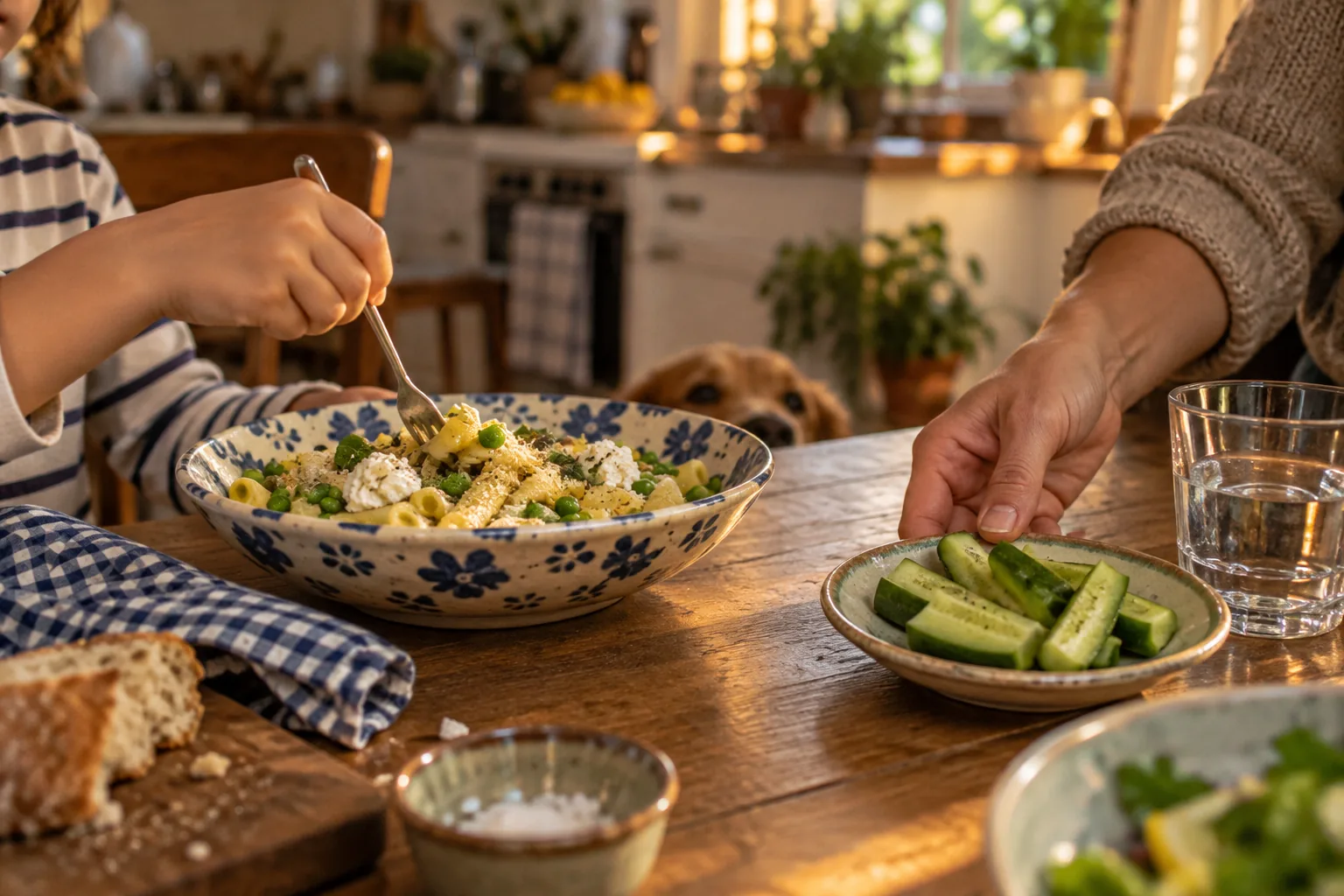
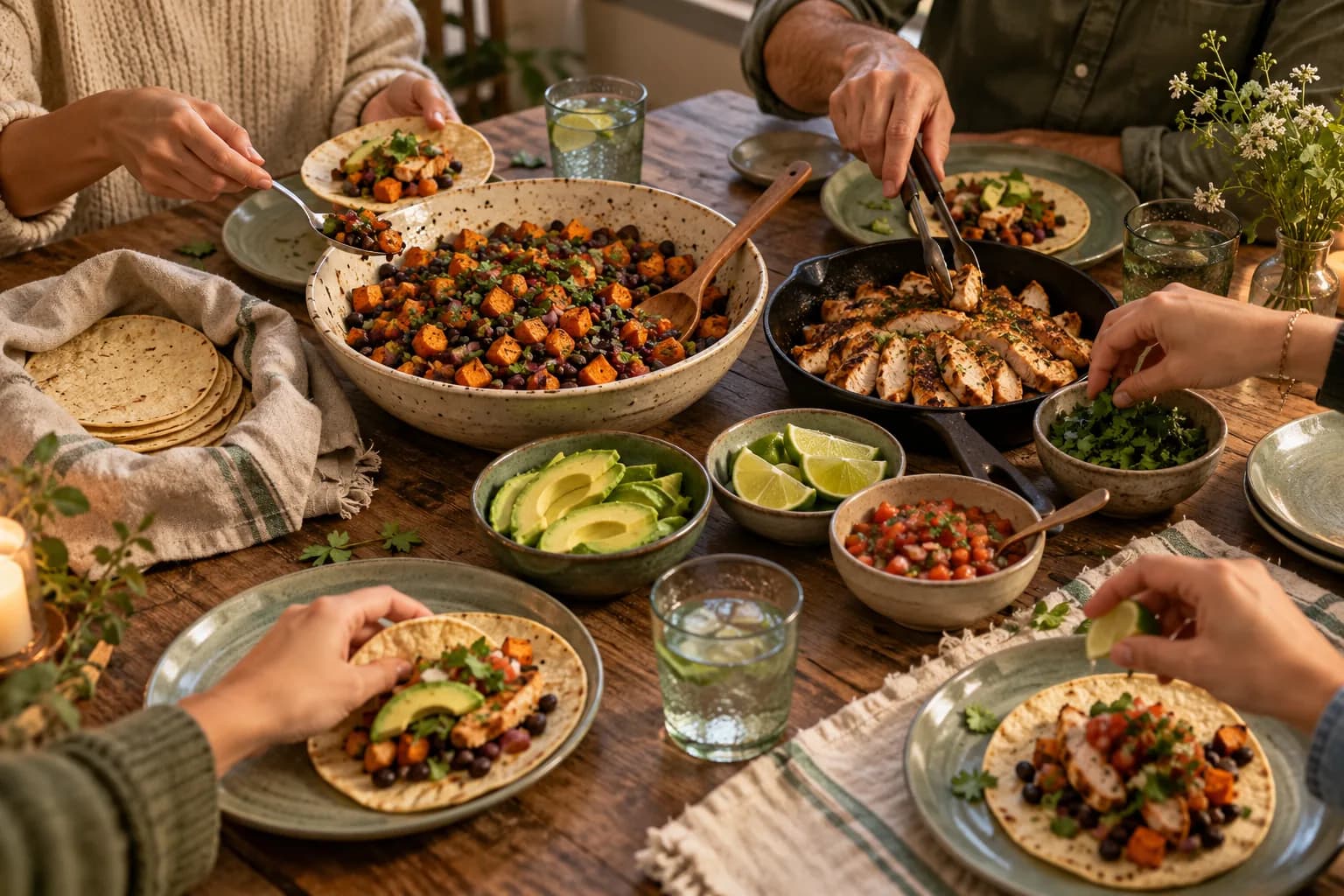
The easiest way to feed a table with different diets is one dinner built on a shared base, with the differences added at the end. Cook a base everyone can eat (grains, beans, vegetables, a good sauce), then put the meat on some plates, the cheese on others, the fried egg on whoever wants one. You cook once, and nobody eats a sad separate plate.
The method has one real limit. It works when the rule is about ingredients, such as vegetarian, dairy-free or no pork. It works less well when the rule is about contact, such as a serious allergy or a kitchen kept kosher. For those the base still helps, but how you cook matters as much as what you cook. This article covers both, and says where to ask the person at the table instead of guessing.
Definition
Shared base with add-ons
A shared base with add-ons is one dinner whose core (a grain, beans or lentils, vegetables and a sauce) suits everyone at the table, with the parts that differ, such as meat, cheese or an egg, cooked and served separately.
4%
of US adults say they are vegetarian, and 1% say they are vegan (Gallup, 2023)
Source: Gallup, In U.S., 4% Identify as Vegetarian, 1% as Vegan
Sort the rules into two piles
Before you plan anything, sort everyone's rules into two piles. Ingredient rules are about what's in the food: vegetarian, vegan, dairy-free, no pork, no alcohol, no shellfish. A shared base solves these cleanly, because you leave the ingredient out of the base and serve it on the side. Contact rules are about what the food touched: a serious allergy, a kosher kitchen, a halal eater who won't eat from a pan that cooked pork. A base doesn't solve these alone, because the risk travels through the spoon, the pan and the splatter.
Some rules can sit in either pile, so ask which one you're dealing with. Dairy-free for taste or a mild intolerance is an ingredient rule. A milk allergy is a contact rule, and butter on a shared spatula counts. The same goes for a vegetarian: some care only about what's on the plate, and others about the pan it came from.
Most tables are mostly the first pile. One vegetarian among omnivores is the classic case, and it's a common one. When there is also a harder rule at the table, add the contact precautions further down. It's the same idea that ends the picky-eater standoff in build the plate, not three dinners: one set of ingredients, and everyone assembles their own.
The base-and-add-on method, dish by dish
The table below splits five dinners this way. Pay attention to the order more than the recipes: the base is cooked first, and the add-on gets its own pan.
| Shared base | Everyone eats | Meat-eater adds | Dairy-free eater |
|---|---|---|---|
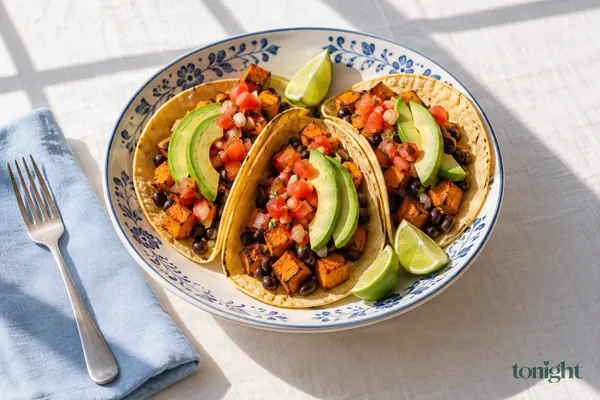
| Sweet potato and black bean tacos | Roasted sweet potato, black beans, corn tortillas, avocado, lime | Chicken or ground beef, seasoned and cooked in a separate pan | Nothing to swap: the recipe has no dairy |
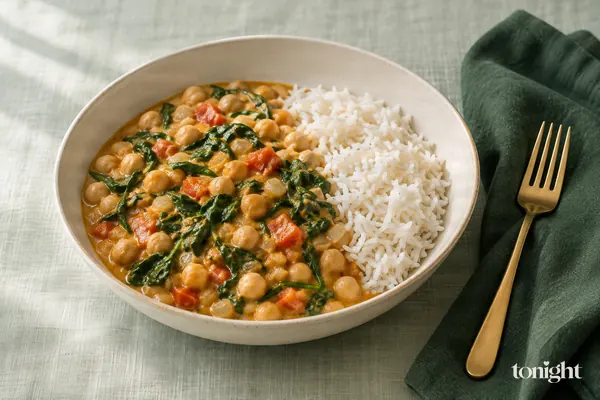
| Chickpea and spinach coconut curry | Curry over basmati rice | Chicken thighs, seared separately and stirred into their bowls only | Nothing to swap: coconut milk, no cream |
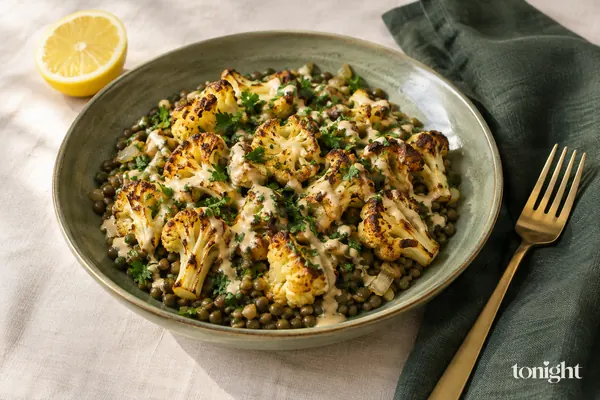
| Moroccan-inspired lentils and roasted cauliflower | Lentils, spiced cauliflower, tahini, lemon, parsley | Grilled lamb or chicken on top | Nothing to swap: the recipe has no dairy |
| Tofu bibimbap-inspired rice bowls | Rice, crisp tofu, carrot, spinach, sprouts, gochujang dressing | Thinly sliced beef or pork, pan-seared | Nothing to swap; skip the egg for anyone avoiding eggs |
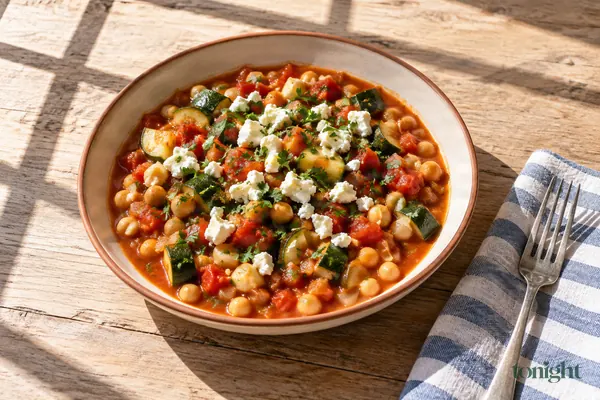
| Greek-style chickpea and tomato stew | Chickpeas, tomato, zucchini, oregano | Browned lamb meatballs or chicken on the side | Leave the feta off the top |
All five bases are vegetarian recipes in Tonight's catalog. The meat add-ons are our suggestions and aren't part of those recipes.
Notice what they share. The protein sits on top of the base or beside it, so it can be left off. The sauce carries the flavor, so the plain version doesn't taste like something is missing. And the meat gets its own pan, because a vegetarian who is happy to eat beside meat may not be happy to eat food cooked in the same pan.
A workable order for a weeknight: start the grain and the base together, and season the add-on while they cook. Then cook the add-on last, in its own pan, so it comes off the heat when the base is ready. Every one of our 148 dinners needs 25 minutes or less of hands-on time, so the extra pan adds minutes, not a second dinner.
Our catalog has plenty of bases to start from. By our own count of the ingredient lists, 31 of the 148 recipes contain no meat, poultry, fish or shellfish, and 25 of those are among the 100 free recipes. Sixteen of the 31 list no milk, and eleven list neither milk nor eggs. A strict vegetarian should still check labels on cheese and paste sauces, which is where the next section comes in. You can browse them all in the recipe library.
Vegetarian dinners that take a meat add-on well

Swaps that do most of the work
A handful of swaps turn ordinary dinners into shared bases. None of them is exotic.
- Vegetable broth for chicken broth. Chicken broth is in 35 of our 148 recipes, and vegetable broth in 11. When you cook a base without the meat, broth is the ingredient that's easy to forget, and the swap keeps the base vegetarian.
- Olive oil for butter or ghee, and coconut milk for cream, when someone is dairy-free.
- Cheese, yogurt and sour cream on the side. The easiest dairy swap is serving it separately instead of cooking it in.
- Beans, lentils or tofu as the base protein, with the meat as a topping instead of the foundation.
- A lemon, tahini or olive-oil dressing in place of a yogurt sauce for the dairy-free eater.
Label reading is part of the job. Parmesan is the classic trap for vegetarians: authentic Parmigiano-Reggiano is made with calf rennet, an enzyme from calves' stomachs, so strict vegetarians may pass on it. Other hard cheeses vary, so check the pack. Tell people what's in the dish when you serve it, and let them decide.
Alcohol turns up in unexpected places, too. In Tonight's ingredient data, ten ingredients carry an alcohol flag: wine, beer and mirin, but also Dijon mustard, miso, gochujang, teriyaki sauce, tamari and vanilla extract. Across the catalog, 34 of the 148 recipes carry the flag. Whether a trace of alcohol in a cooked sauce matters is for the person who avoids alcohol to say, so ask before you decide for them.
Cross-contact: when sharing a pan stops being fine
For allergies, cooking doesn't fix the problem. Food Allergy Research & Education (FARE) describes cross-contact as one food touching another so that their proteins mix, and it states that cooking does not reduce or eliminate the chance of a reaction. US law names nine major allergens: milk, eggs, fish, crustacean shellfish, tree nuts, peanuts, wheat, soybeans and sesame. If someone at your table has an allergy, treat what follows as rules, not tips, and ask them (or their doctor or allergist) what their household needs. Our guide to reading allergen labels goes further on the packaging side.
A cook order that keeps dinners apart
- 1
Wash hands and equipment first
Use soap and warm water on your hands. FARE reports that bar and liquid soap remove allergen protein from hands and alcohol-based sanitizer doesn't. Pans, boards and utensils should be washed with soap and water too.
- 2
Cook the sensitive dish first
Start with the allergen-free, vegetarian or dairy-free component in clean pans. FARE's advice is to cook the allergen-free meal first.
- 3
Cover it and move it away
Put a lid on it and keep it clear of any splatter before the add-on goes into a pan.
- 4
Cook the add-on in its own pan
A separate pan, a separate spoon, a separate board. Chicken for the meat-eaters never touches the chickpeas.
- 5
Give every dish its own serving utensil
The spoon for the meat stays with the meat, and the same goes for the cheese.
- 6
Plate the strictest rule first
Serve the person with the tightest requirement before the add-ons reach the table.
How strict to be depends on the person. For its Vegan Trademark, the Vegan Society asks that vegan food be prepared with separate utensils, or with utensils washed thoroughly between vegan and non-vegan use. Individual vegetarians differ on shared pans, so ask once and remember the answer.
Packaged food needs its own attention. In the US, advisory statements such as “may contain” or “produced in a facility with” are voluntary, and the FDA notes they aren't required by law. A missing warning is not a guarantee, and formulations change, so read the whole label every time.
Sometimes the base has to be the whole dinner. If one person has a serious allergy and another keeps kosher, the simplest answer is a dinner that suits both completely, with no add-ons, cooked in clean equipment and served with clean spoons. It is less flexible, and it is far easier to get right than a dinner with three exceptions.
Religious rules: keep it general, and ask
Halal means permissible under Islamic law. In food terms that excludes pork and its by-products, alcohol and intoxicants, and blood, and it requires meat to come from animals slaughtered according to Islamic requirements. Halal certifiers write standards that keep halal meat separate from non-halal meat and equipment. How strictly a household applies that at home is for that household to say.
Kosher rules, as the Orthodox Union summarizes them, forbid certain animals, including pork and shellfish, require kosher meat to be slaughtered in a prescribed manner, and don't permit meat and dairy to be eaten or cooked together. Processed foods need certification, because a non-kosher ingredient or process can affect food that looks ordinary. Observance extends to equipment: the OU says a dairy product may not be heated on equipment used for meat, and the reverse. A kosher-keeping guest may not be able to eat from a pan that has cooked non-kosher meat, or mixed meat and dairy, and whether your kitchen can work for them is their call.
Pork is flagged in 21 of our 148 recipes, about one in seven, so a no-pork rule removes some dinners but leaves plenty. The catalog can't tell you more than that, and it shouldn't try. The advice for both traditions is short. Buy certified products (a recognized halal certification, or a kosher symbol such as the OU's) instead of judging from an ingredient list. Ask the eater what they need. Follow their guidance, and their community's, over ours.
Where Tonight fits
Tonight works from the same idea in a stricter form. You set each person's rules once (allergies with a severity, diets, halal, kosher, no pork, no alcohol), and a dinner only makes your week if it passes for every person at the table. If Sam is vegetarian and Nour can't have peanuts, one dinner works for both. If nothing safe fits, it says so instead of guessing. Tonight doesn't split a dinner into per-person add-ons today, so the add-ons stay yours to improvise.
It also can't see the pack you bought. For halal and kosher households, meat dishes carry a reminder to buy certified meat, and the certified pack is what settles it. If you'd like to see how this works for your own table, Tonight is free to try for 7 days, and Allergies are rules, not suggestions explains the checking in detail.
Questions people ask
How do you cook for a vegetarian and a meat-eater at the same time?
Cook a vegetarian base (grains, beans or lentils, vegetables and a sauce), then cook the meat separately in its own pan and serve it on the side or on top. Everyone eats the same dinner, and the vegetarian's plate never touches the meat.
Can you cook vegetarian and meat dishes in the same pan?
It depends on the vegetarian, so ask once. If the difference is an allergy, use separate, washed equipment and cook the allergen-free dish first, as FARE advises.
How do you cook for a dairy-free eater at a mixed table?
Keep dairy out of the base and serve it on the side. Cheese, yogurt and sour cream go on the table, not in the pot. Use olive oil for butter and coconut milk for cream, and read the labels on broths and sauces.
Can I check halal or kosher meat myself?
Not from an ingredient list. Buy meat with a recognized halal certification or a kosher symbol, and ask the eater which certifiers they trust. Tonight puts a reminder to buy certified meat on dishes with meat for halal and kosher households for this reason.
How common is vegetarian eating in the US?
In Gallup's July 2023 survey of 1,015 US adults, 4% identified as vegetarian and 1% as vegan.
Sources
- 1.Gallup, In U.S., 4% Identify as Vegetarian, 1% as Vegan — 4% vegetarian and 1% vegan among 1,015 US adults, July 2023.
- 2.Food Allergy Research & Education (FARE), Avoiding Cross-Contact — Definition of cross-contact; soap and warm water; clean utensils; cook the allergen-free meal first; cooking does not remove the risk.
- 3.US FDA, Food Allergies — Nine major allergens; advisory statements are voluntary; read labels every time.
- 4.The Vegan Society, How the Vegan Trademark checks cross-contamination — Separate or thoroughly washed utensils for vegan preparation.
- 5.OU Kosher, What Is Kosher? — Forbidden animals, meat and dairy separation, kosher slaughter, certification of processed foods.
- 6.OU Kosher, OU Symbols Explained — Dairy and meat symbols; dairy and meat equipment may not be shared.
- 7.Halal Food Council USA, Halal Food 101 — Meaning of halal; pork, alcohol and blood prohibited; certification bodies.
- 8.American Halal Foundation, AHF Halal Standards — Pork and alcohol prohibited; slaughter requirements; segregation of halal from non-halal meat and equipment.
- 9.PMQ Pizza Magazine, How Parmigiano-Reggiano D.O.P. Is Made — Production rules call for calf rennet.
- 10.Tonight recipe catalog (148 recipes, September 2026)