Sheet pan dinners: the formula, roasting times, and mistakes
How to make a sheet pan dinner work: the protein, vegetable, fat and seasoning formula, roasting times at 425°F (220°C), and the mistakes that steam the tray.
Av The Tonight team · · 9 min lesetid
Denne siden er foreløpig bare på engelsk.
A sheet pan dinner is a protein and vegetables roasted together on one rimmed tray in a hot oven, around 425°F (220°C), timed so everything finishes at the same moment. The formula behind nearly every good one is a protein, a vegetable, a fat and a seasoning, with something sharp or fresh added after the oven.
The catch is that food doesn't cook at one speed. Potatoes want 30 to 45 minutes at that heat, green beans 10 to 20, a salmon fillet about 15. You close the gap with two levers, in this order: cut the slow things smaller, and add the quick things later. Fifteen of our 148 dinners are traybakes, and they show the payoff: a median of 45 minutes on the clock, and only 18 of them yours.
The formula: protein, vegetable, fat, seasoning
Definition
Sheet pan dinner
A sheet pan dinner is a complete meal, usually a protein plus vegetables, roasted together on one rimmed baking sheet at high heat, typically around 425°F (220°C). Our catalog files these under the dish type “traybake.”
Protein. Pick something that finishes in the window your vegetables need. Fish fillets, chicken thighs and drumsticks, and pork tenderloin or chops are the usual cast. Salmon and cod anchor five of our traybakes, which makes sense: a fillet takes about 15 minutes at this heat, so it can slide in at the end.
Vegetable. Choose by roasting time, not by color. The table below sorts them into groups, and the trick is to put one slow vegetable and one quick one on the same tray, then stage them.
Fat. Oil carries heat and browning. University of New Hampshire Extension suggests 1 tablespoon per 4 cups of cut vegetables, and the University of Kentucky uses a tablespoon for 1 to 2 pounds. Our four-serving trays carry a protein too, and most use 2 to 3 tablespoons of olive oil.
Seasoning, then a finish. Salt and spices go on before the oven. Sugary glazes wait. Our barbecue chicken drumsticks get their sauce for the last six minutes, and the recipe says why: apply the sauce near the end so its sugars do not scorch. After the oven comes the bright part, whether that's lemon over Nordic trout, a tahini dressing on salmon, or balsamic vinegar stirred through hot potatoes.
Potatoes turn up in six of our 15 traybakes, which tells you what home cooks reach for. These combinations are already tested:
- Cod with potatoes and carrots, under a chermoula of herbs and lemon
- Trout with fingerling potatoes and green beans
- Pork tenderloin with potatoes, onion and green beans
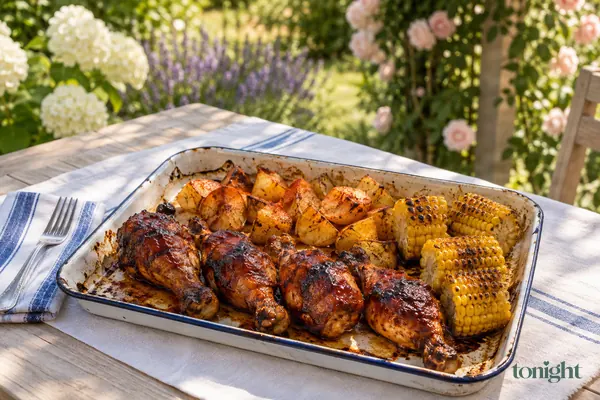
- Chicken drumsticks with potatoes and corn
- Salmon with broccoli, served over rice
- Cod with lemon potatoes, cherry tomatoes and olives
A tray also has limits. Everything shares one oven temperature and there is no pan sauce, so it suits dishes where the protein and the vegetables agree on heat. Wet, saucy dishes belong in a pot.
Match the cut to the clock
Timing is the whole game. University guidance puts vegetables at 425°F somewhere between 10 minutes and an hour, depending on the type, and it agrees on the rule that makes a tray work: smaller pieces cook faster, and larger pieces take longer.
| Vegetable | Minutes at 425°F | In our traybakes (220°C) |
|---|---|---|
| Potatoes, carrots, beets | 30–45 | 2 cm potato chunks: 34–54; thick carrot sticks: 38 |
| Onions | 30–45 | Onion wedges: 34 |
| Winter squash | 20–60 | – |
| Broccoli, cauliflower, Brussels sprouts | 15–25 | Broccoli florets: 15 |
| Zucchini, summer squash, bell peppers | 10–20 | – |
| Asparagus, green beans | 10–20 | Green beans: 10–17 |
| Tomatoes | 15–20 | Cherry tomatoes: 24 |
Ranges from the University of Kentucky, adapted from The Kitchn. Our times are the minutes each vegetable spends in the oven in our published recipes; a dash means we have no comparable roasted tray. Pan color, oven and piece size all shift them, so check early.
Two things fall out of the table. The slowest and quickest groups differ by a factor of three, so you can't throw everything on at once. And our own recipes mostly sit inside the university ranges, with one honest outlier: potatoes run 34 to 39 minutes in three of our trays and 54 in the Greek-style cod, where they go in first and the tomatoes, olives and fish join later. Treat every number here as a starting point and check early.
The method, in order
A sheet pan dinner, start to finish
- 1
Heat the oven to 425°F (220°C).
Put a rack in the middle, as the University of Kentucky advises. Seven of the twelve traybakes with published steps in our catalog run at 220°C, and the rest run at 200°C or lower.
- 2
Cut by density.
Dense vegetables like potatoes and carrots go in pieces of about ½ to 1 inch (1 to 2.5 cm), the size University of New Hampshire Extension suggests. Softer ones like broccoli and green beans can stay larger. Portion the protein evenly, too.
- 3
Dry, oil, season.
Pat vegetables dry, because the drier they are, the better they roast. Toss with oil and salt until every piece shines.
- 4
Spread in a single layer.
Leave a little space between pieces. Our recipes are written for four servings per tray, and if you are cooking for six, use two trays rather than piling it higher.
- 5
Stage the tray.
Dense vegetables go in first. The protein joins for the last stretch of its own cooking time, with the quick vegetables beside it. Our chermoula cod roasts potatoes and carrots for 25 minutes, then nestles the cod in for 13 more.
- 6
Turn once, check early.
Stir or turn the vegetables every 10 to 15 minutes, and check the thinnest piece of fish first. Several of our recipes carry that same tip.
- 7
Take the temperature.
USDA's safe minimums are 145°F (63°C) for fish, 165°F (74°C) for poultry, 145°F with a 3-minute rest for pork chops and roasts, and 160°F (71°C) for ground meat.
- 8
Finish at the table.
Add lemon, herbs, yogurt or a dressing, taste, and adjust the salt.
Here is staging in practice, from our Nordic-inspired trout and potatoes at 220°C:
- 1Minute 0: halved fingerling potatoes, tossed in olive oil and salt, go in alone.
- 2Minute 22: green beans are scattered over the potatoes.
- 3Minute 29: trout portions, brushed with melted butter, are nestled in among the vegetables.
- 4Minute 39: the tray comes out and gets dill and lemon. The trout should be flaky and at 63°C.
How long each protein spends on the tray
Vegetables set the schedule, but the protein sets the finish. This is what it looks like in our published recipes, all at 220°C and all for four servings.
| Protein | Safe minimum (USDA) | On the tray | Watch for |
|---|---|---|---|
| Salmon fillets | 145°F (63°C) | 15 min | Thin portions finish first |
| Cod fillets | 145°F (63°C) | 12–13 min | Check the thickest piece |
| Trout portions | 145°F (63°C) | 10 min | Flaky and 63°C |
| Pork tenderloin | 145°F (63°C), 3-minute rest | 22 min, then 6 resting | Remove promptly at temperature |
| Chicken drumsticks | 165°F (74°C) | 43 min, glazed at the end | Test away from the bone |
Times from the published methods of our traybake recipes. Ovens and pieces vary, so always confirm with a thermometer.
Read down the table and the pattern is plain. Fish finishes in 10 to 15 minutes, so it is the easiest protein for a tray: the vegetables set the schedule and the fish drops in at the end. Pork tenderloin needs about 22 minutes plus a rest, and bone-in chicken needs most of 45. With those, the protein and the potatoes go in close together, and the quick vegetables are the ones you stage. Pick the protein first and the rest of the tray follows.
Five mistakes that make a sad tray
Piling it on
A crowded tray steams. The University of Kentucky says to keep vegetables in a single layer with a little space between them, and University of New Hampshire Extension notes that crowded pans take longer. The standard rimmed half sheet pan is 18 by 13 inches (46 by 33 cm). If food is piled up, split it across two trays.
Putting everything in at once
Timing is a schedule. Give the potatoes a head start, add the beans partway, and hold the fish for last. The table above tells you the order.
Wet vegetables and too little oil
Pat washed vegetables dry, because the University of Kentucky notes that the drier the vegetable, the better it roasts. Then use enough oil that every piece is coated.
Glazing too early
Barbecue sauce, honey and other sugary glazes scorch long before a drumstick is done. Brush them on for the last few minutes, and use a clean brush for anything that goes on cooked food.
Skipping the thermometer and mishandling raw chicken
Cook to the temperature, not the color: 165°F (74°C) for chicken, measured with a food thermometer. The CDC also says raw chicken doesn't need washing, and advises a separate cutting board for it. Never put cooked food on a surface that held raw chicken.
Traybakes to cook this week
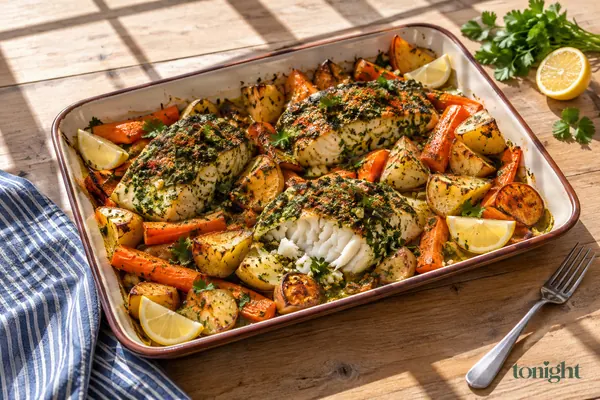
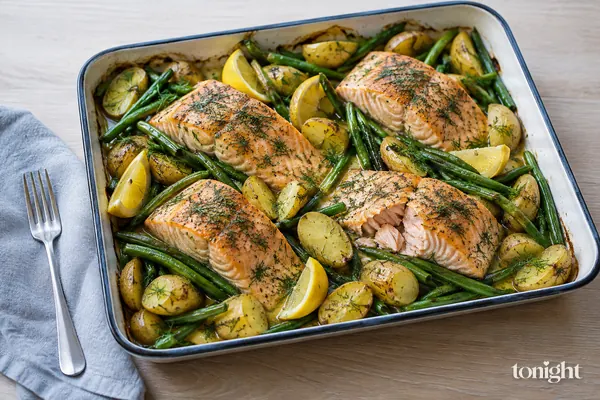
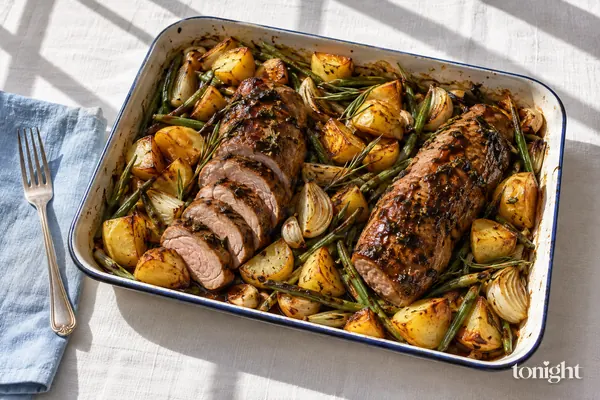
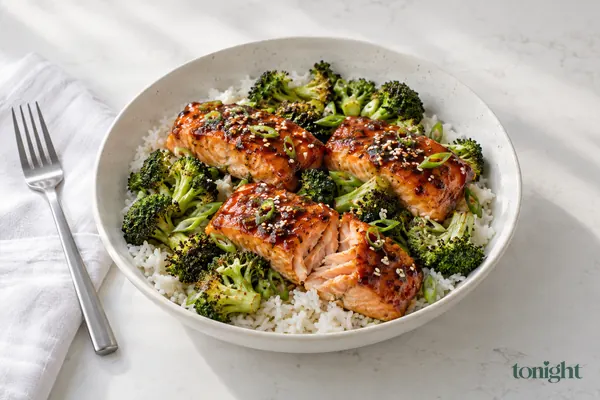
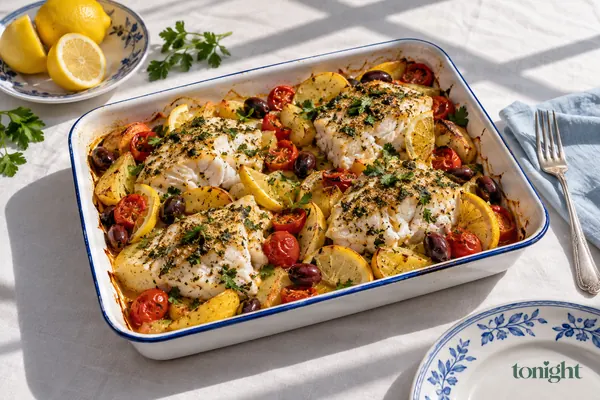
A traybake is the dinner for the night you are home but stretched. Tonight weighs hands-on time and total time against the evening you actually have, and in Browse recipes you can filter by dish type and hands-on time to see all fifteen traybakes at once. Six of them are also freezer-friendly, which the freezer-friendly dinners guide explains how to use.
If you are short on time rather than effort, the weeknight dinner ideas guide shows how to read a recipe's real clock, and the pantry staples list covers the oils, spices and sauces that finish a tray. You can see the whole recipe library or try Tonight free for 7 days.
Questions people ask
What temperature should a sheet pan dinner cook at?
Around 425°F (220°C) suits most trays, and it is the temperature university guidance uses for roasting vegetables. Seven of the twelve traybakes with published steps in our catalog run at 220°C, and the others use 200°C or lower.
Can you cook raw chicken and vegetables on the same pan?
Yes, as long as the chicken reaches 165°F (74°C) by thermometer and you keep boards and utensils that touched raw chicken away from cooked food. The CDC says raw chicken doesn't need washing.
What size sheet pan should I use?
A rimmed half sheet pan, 18 by 13 inches (46 by 33 cm), is the standard size. A full sheet, 26 by 18 inches, is too large for most home ovens.
Should I use the convection setting?
It can work. A common rule is to lower the temperature by 25°F (about 15°C) or shorten the time by about 25%, and to start checking early. Confirm doneness with a thermometer, not with a golden surface.
How long do sheet pan leftovers keep?
Cooked meat and fish dishes keep 3 to 4 days in the refrigerator, according to the FDA's storage chart. Refrigerate them within two hours of cooking, and reheat to 165°F (74°C).
Sources
- 1.Tonight recipe catalog (148 recipes, September 2026) — Traybake counts, times, oven temperatures and step timers.
- 2.University of Kentucky, Roasted Vegetables (adapted from The Kitchn) — Roasting times at 425°F by vegetable group, single layer, drying and oil.
- 3.University of New Hampshire Extension, Fresh Vegetables, Roasted — 425°F, ½- to 1-inch pieces, 1 tablespoon oil per 4 cups.
- 4.USDA Food Safety and Inspection Service, Safe Minimum Internal Temperature Chart — Safe internal temperatures (USDA PDF, hosted by K-State Research and Extension).
- 5.CDC, Chicken and Food Poisoning — Do not wash raw chicken; separate cutting board; 165°F.
- 6.FDA, Refrigerator & Freezer Storage Chart — Leftovers keep 3 to 4 days; freezer times.
- 7.FDA, Are You Storing Food Safely? — Two-hour rule for perishable food.
- 8.Wikipedia, Sheet pan — Half sheet 18 by 13 inches; full sheet 26 by 18 inches.
- 9.Food Republic, How to Adjust Any Recipe for Convection Oven Cooking — Lower 25°F or cut time 25%; check early.